
Developing Emergent Readers

The kindergarten years are important years where solid foundations are laid - foundations on which future academic success are set, if you will, in foundational stone. During these early years it is of upmost importance to teach deep — not wide!
Kindergarten foundational standards must be over-taught; they must be practiced again and again and again to bring students to the level of Rapid Automatized Naming (RAN). The ability to rapidly name a letter, a sound, a beginning sound, a segmented word, sounds in a word, a rhyming word, etc. has proven to be a stronger predictor of future reading success than even the associations of how letters fit together to form words. RAN is “the seemingly simple task of naming a series of familiar items as quickly as possible and appears to invoke a microcosm of the later developing, more elaborated reading circuit.” (Denckla & Rudel 1976). Further studies on RAN have led researchers to determine that the ability to rapidly name and produce early reading concepts builds the working memory and eye function that connects orthography and phonology! (Journal Scientific Studies of Reading 2018).
“ “If you do not build a foundation properly, it can be dangerous and very expensive to repair”. Lillian Katz”

What does this mean for an early educator of kindergarten? This means less is more! We must make sure that our students are being “over-taught” the things that will lead them to achievement, rather than moving from those important skills too early, rushing into skills that belong to, and must stay in the 1st grade! Kindergartners need to have an instamatic mode of kindergarten core standards. Think of young learners as apprentices. Young apprentices work to learn something really well! They develop mastery; then and only then, they move that mastery to the connection of other skills and understandings.
RAN in short is automaticity! The ability to recall something without conscious thought. In reading — the ability to save brain power for comprehension —- the ability to focus on content. If such automaticity is achieved, students rapidly make the shift from learning to read to reading to learn without noticeable effort! Here are a few ways to develop RAN with your emergent readers.

Don’t overload a reader with too many concepts at once, thus, jumbling the pathways to the brain. When too much information is given, it becomes difficult to retain.
Teach skills using a timeline for reading success. The sequence of skills does matter, just as when building a house you pour the foundation before building the walls. If you are lucky, you have a curriculum to use as a guide. Follow it — it is there to help keep you focused on what needs to be taught.
Remember achieving automaticity is not automatic. Rather, it requires repeated practice time and time again. Skills can be practiced over and over again in fun and engaging ways. Even when the skill appears to be mastered, it must be reviewed time and time again in a spiraling fashion. If the learning is fun, kids thrive with repetition.
Take frustration out of the situation. For example if a student is struggling with naming 52 letters in one minute, practice rapid naming with things like common objects, colors, etc. This allows a child to feel success with automaticity —- getting an idea of exactly how automatic naming feels.
Teach skills using fun and games. Students do not respond well to worksheets or other kill and drill models. So, pull out the games and allow students to practice automatic naming in fun and creative ways. Turn those worksheets and flashcards into fun and creative games.
Guide students to make connections with beginning reading concepts. Make alphabet books, create poetry and rhyme, match words with the same beginning, middle, or ending sound — create a “Why we Match” book. Provide opportunities for manipulative play with early concept materials.
Know your grade-level standards. If it is not a standard, save it for the enrichment of advanced students as they become completely automatic with their own grade-level skills. Have you noticed drops in what a child could do at the end of kindergarten in relation to what they know at the beginning of 1st grade? This drop can be directly correlated to the lack of automaticity with the given skill in kindergarten. The child could produce the skill, but not automatically. He/she was still using up too much brain power to produce the results. For example, if a child can ride a bike at the end of kindergarten and lays it on the lawn until the beginning of 1st grade, will they be able to ride the bike as easily after the summer break? Yes! Because the skill of riding a bike is automatic — no brain power needed.
You will be amazed at how students thrive when automatic brain-power of kindergarten-level standards is the focus in a kindergarten classroom — enveloped in an environment where pushed-down curriculum is not welcomed, where students are allowed to learn at a development pace and truly apprenticed in early reading Kindergarten-Level skills.
Read or listen to more here:

Also available at Teachers Pay Teachers!
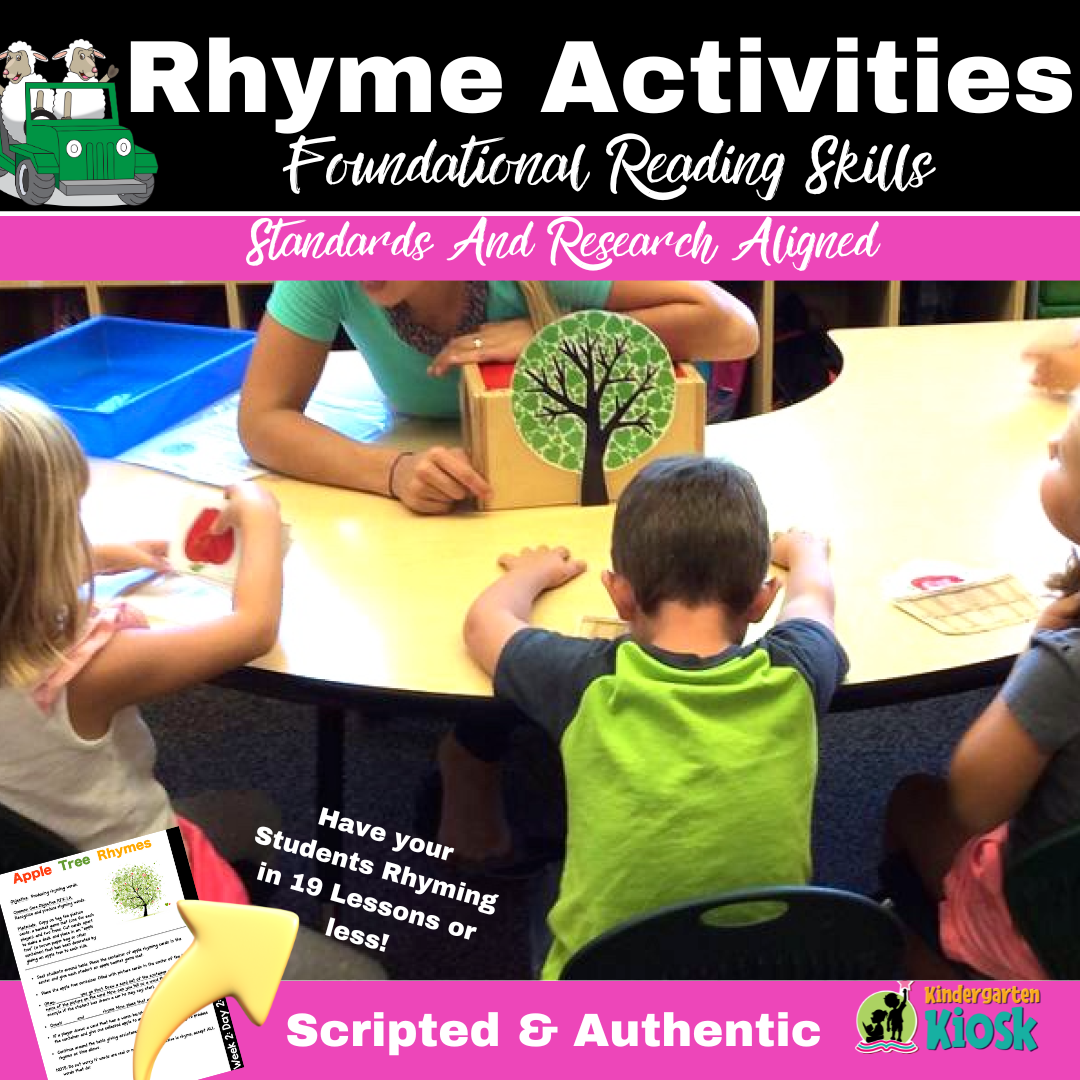
This packet includes activities to help your students understand the concept of rhyming. The lessons vary in style and format. Some lessons are scripted, others are designed for independent practice. Some lessons can be used with small groups while others can be completed with a large group. All lessons can be adapted to support struggling students or to challenge high-achieving students.
The unit is organized into 19 lessons to be spread out during 7 weeks. Many of the Teach Me To Read Units are meant to be taught in tandem, following the learning to read timeline.
Here is the link for the syllable unit: https://www.teacherspayteachers.com/Product/Teach-Me-To-Read-Syllables-833730
Table of Contents Week 1 Day 1: Nursery Rhyme Time
Week 1 Day 2: The Hungry Duck
--------------------------------------
Week 2 Day 1: Buggy Rhymes
Week 2 Day 2: Apple Tree Rhymes
--------------------------------------
Week 3 Day 1: Web Treasures
Week 3 Day 2: Roll and Rhyme Halloween (or any season)
Week 3 Day 3: Halloween Rhyme Time
--------------------------------------
Week 4 Day 1: Picture Pairs
Week 4 Day 2: Rhyming Flags
Week 4 Day 3: Turkey Lurkey Rhymes
--------------------------------------
Week 5 Day 1: Rhyme Me a River
Week 5 Day 2: Le Revelillon
Week 5 Day 3: To The North Pole
--------------------------------------
Week 6 Day 1: The Lost Mitten
Week 6 Day 2: Planes Trains and Everything Else
Week 6 Day 3: Match a Rhyme
--------------------------------------
Week 7 Day 1: Rhyming Sunglasses
Week 7 Day 2: Home Tweet Home
Week 7 Day 3: T-Shirt Twins

Also available at Teachers Pay Teachers!
Syllables Games and Activities
This packet includes activities to help your students understand the concept of syllables. The lessons vary in style and format. Some lessons are scripted, others are designed for independent practice. Some lessons can be used with small groups while others can be completed with a large group. All lessons can be adapted to support struggling students or to challenge high-achieving students.
The unit is organized into 16 lessons to be spread out during 4 or more weeks.
Contents:
Week 1
Clapping Names
Syllable Objects
The Syllable Walk
Syllable Count
Week 2
Color Walk
Off To See The Wizard
Family Fun
Syllable Sale
Week 3
Animal Sort
The Country Store
Squirrel Sort
Race Up the Ladder
Week 4
Counting Syllables
I Can Syllables
Pumpkin Patch
Haunted House Syllables
© Kathy Crane Kindergarten Kiosk
Related Products
Follow For Updates and Freebies!
Be alerted as products are updated and/or added to. Get Special Freebies.

Also available at Teachers Pay Teachers!
Are you looking for some great games that can be used to teach your students or homeschool students how to segment phonemes with fluency, the essential precursor to decoding? You will love this great packet! Helps with your Dibels scores too!
Games include:
Fingerprint CVC Words
The Big Game
BAM
Boo!
Simon Says Segmenting
Floating Sounds
Ladybug Dance
Santa Gets Dressed
“Great purchase! I printed everything off and prepped all the games. Put everything in its own sheet protector and placed in a binder. Now I just pull out a game and it is ready to go. What are the three greatest things about Kindergarten Kiosk purchases.... 1) educationally top notch (Kathy knows her stuff and knows how to effectively teach the concepts while the kids are having a great time.) 2) LOVE that the games...because that what they all are...are scripted! They can be handed to a parent volunteer or sub and away they go! 3) time tested (research based :) ) These are the very same games that Kathy has used for years, they weren't just made up and published quickly to make a few extra dollars. They are TIMELESS! I've loved EVERY purchased from Kindergarten Kiosk and look forward to many years ahead of using these resources.”
Also available at TPT.
Product Description
CVC Word Work
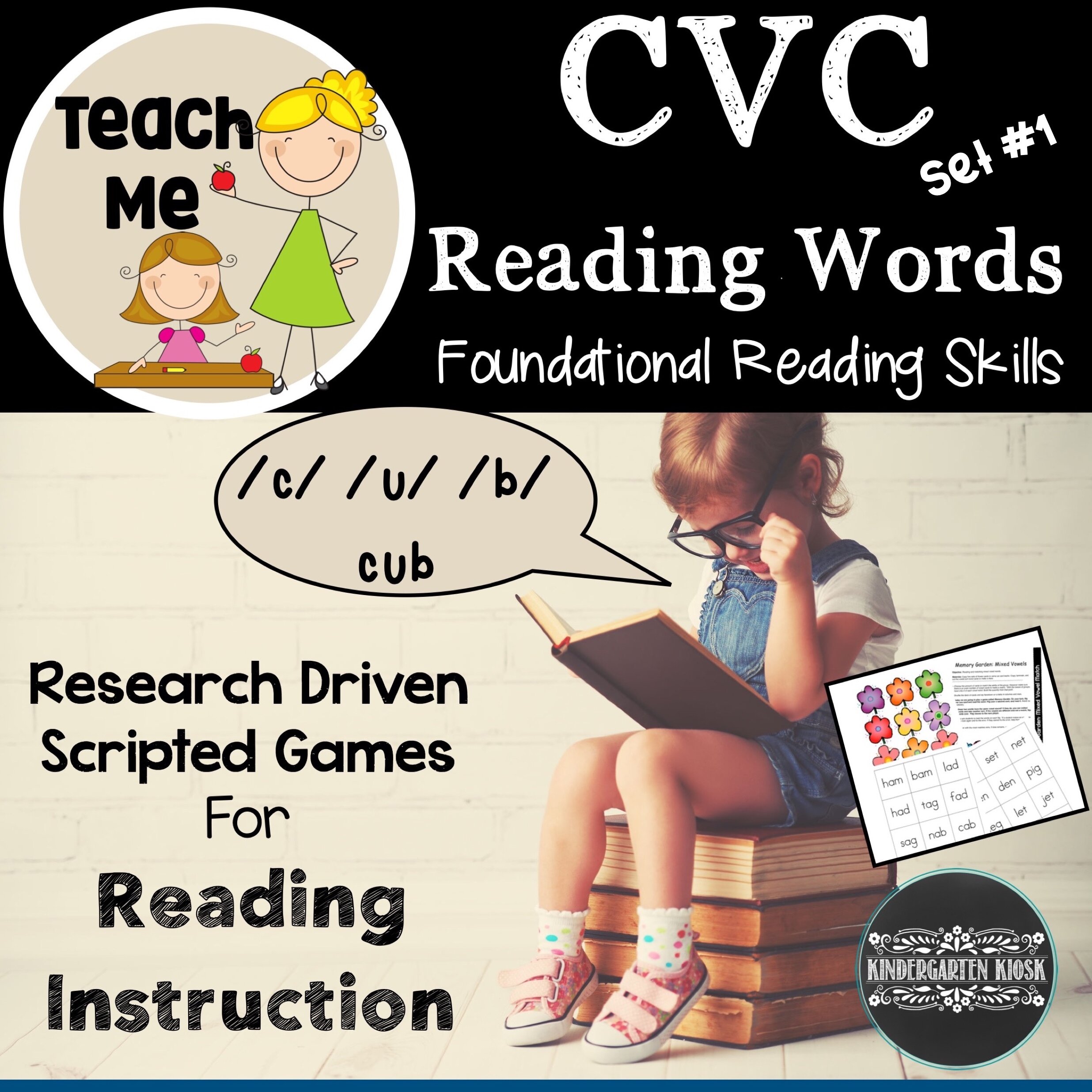
Are your students like mine and need continual practice with CVC words? From my young kindergartners to the oldest of my reading intervention students, everyone benefits from practice with vowel consonant vowel patterns
The Contents of the CVC packet are all written in a scripted format for easy delivery.
Trace the Vowel Practicing Vowel Sounds
Flower Garden Sorting CVC Words
Memory Garden Reading and Matching Mixed Vowel Words
Watering Flowers Writing CVC Words
Whack-it Reading and Whacking CVC Words
Roll and Write Writing CVC Words
© Kathy Crane Kindergarten Kiosk
Related Products
Follow For Updates and Freebies!
Be alerted as products are updated and/or added to. Get Special Freebies.
Also available at Teachers Pay Teachers!
Product Description
Onset Rime Foundational Reading Skills
Blending and segmenting onsets and rimes of single-syllable spoken words is an important skill to prepare young readers to blend and segment. Teach this skill with confidence by playing these simple games with your students.
Contents
Bookstore Sale
Construction Zone
Color the Picture
Planting Flowers
© Kathy Crane Kindergarten Kiosk
You Might Also Like
Nonsense Words Lessons and Games
Beginning Middle and Ending Sounds Lessons and Games
Follow For Updates and Freebies!
Be alerted as products are updated and/or added to. Get Special Freebies.

Building a bank of sight words with early readers allow students to become better readers! Introducing those words in a variety of ways will help meet the needs of a diverse class of learners. These fun, varied, games will be a hit in your classroom. These games focus on the first 200 Fry sight words as well as sight word phrases. They are easily differentiated to meet the needs of your group.
Contents include:
Top Knight
The Monster Party
Dinosaur Friends
Munchy Munch
Collecting Bugs
Related Products • Sight Word Kindergarten Readers First 12 Common Sight Words • Sight Words and Sentence Activities • Sight Words: Word-Wall Kit
• Building Sight Word Sentences
• Building "Action" Sight Word Sentences
• Sight Words: Teach Me to Read
• Sight Words and Sentence Activities
• Sight Word Kindergarten Readers First 12 Common Sight Words
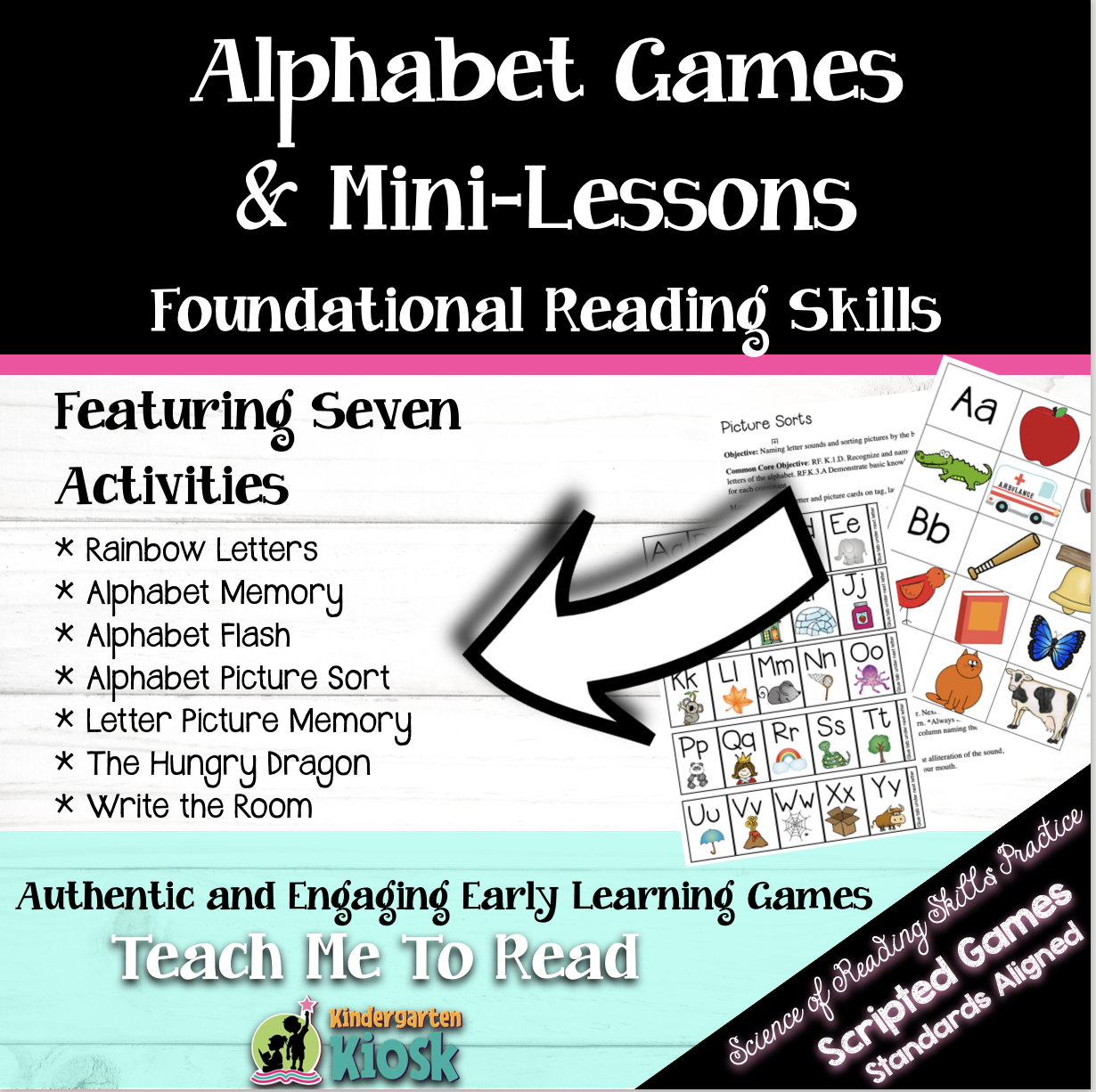
These alphabet games for Learning Centers, and Small Targeted Groups are created using the latest research on reading instruction that really works. This packet focuses on crucial alphabet skills that can be easily taught and practiced in small groups. They can also be used in classrooms, homeschool, and intervention centers with confidence as they are scripted for easy delivery and standards based!
Contents Include:
Rainbow Letters
Alphabet Memory
Alphabet Flash
Alphabet Chant
Alphabet Picture Sorts
Letter/Picture Memory
The Hungry Dragon
Write the Room
Strategically practicing important reading skills will make your students or child improved readers!
Also available at Teachers Pay Teachers!
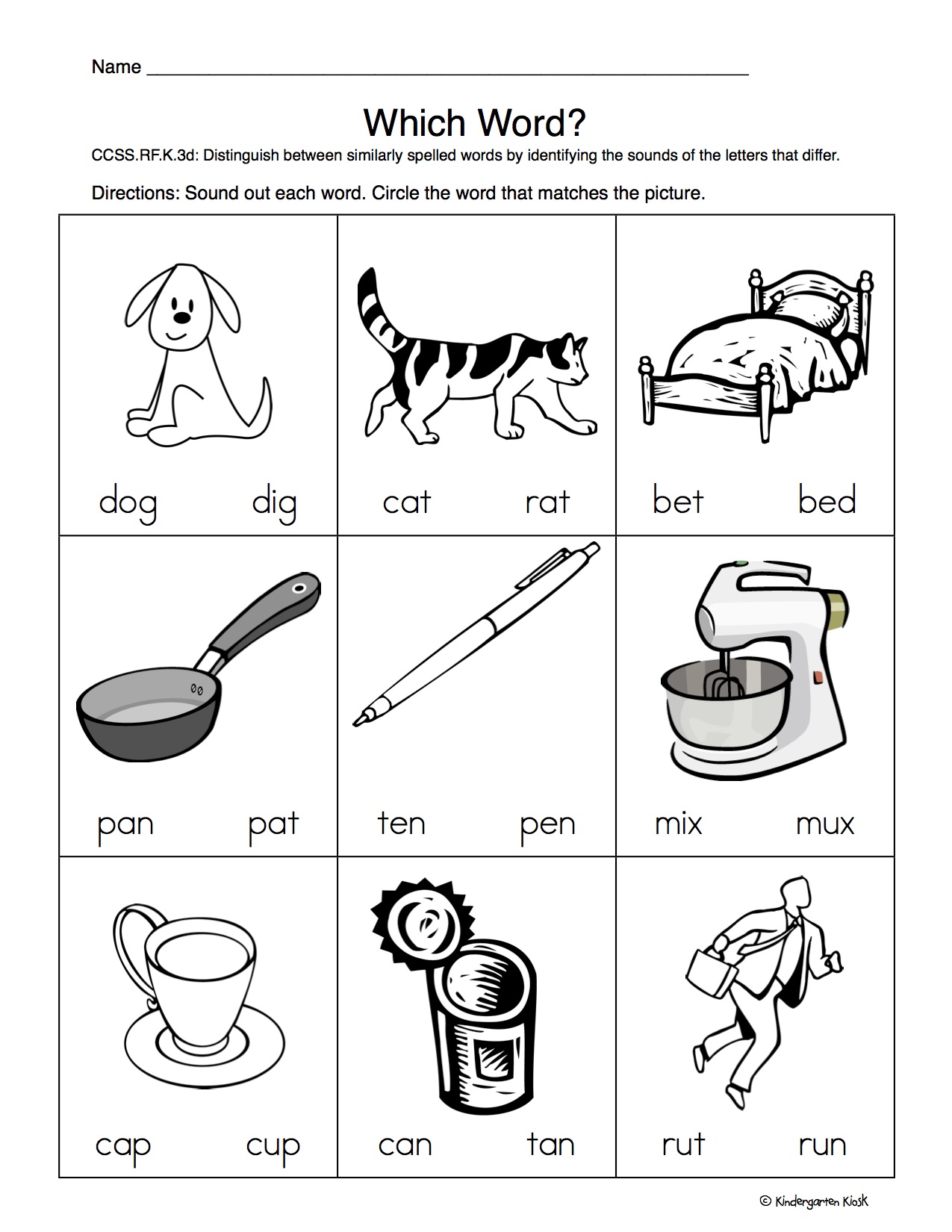
One of the goals of the Common Core Strands of Phonics and Word Recognition is to help students use sounds to read words. Working with consonant and vowel sounds, Nonsense Words, CVC words, and high frequency words helps students move into reading.This packet includes lessons, games, and worksheets to help your students decode real and nonsense words.