
Using Music With Young Children

I often feel that it's my responsibility as an early educator to combat the barrage of music children are exposed to. Nothing against the pop stars that our kindergartners adore, but listening to such pop music is not going to help them develop and strengthen their musical abilities. Not that I think there's anything inherently wrong in young children listening to pop music, it's just that I feel it's the job of the educator to be aware of what kind of music should be incorporated into the classroom.
Appropriate Music for Young Children

The most appropriate music for young children is unaccompanied. When you sing with children without the distraction of an accompaniment they are better able to hear your voice and their own and make necessary adjustments in order to match pitch. If an accompaniment is needed it should be a simple one. The guitar is actually a better instrument than the piano for a young child to sing along with (and it's easier to learn how to play).
-Music for children should be free of embellishment. It drives me crazy when I buy a CD of music for children and the singer slides around from note to note and adds unnecessary flourishes. Young children are still learning how to match pitch. Embellishments are distracting and confusing.
-Children's music should be played slowly. Music with a fast tempo is fun for dancing, but when children are learning to sing, they need to be able to hear each note clearly. When singing with children, slow down and let them hear each individual pitch.

-Appropriate music is of an appropriate range. There is research that has determined what that range is, but I hesitate to post that here because I have noticed a great variety in children's abilities. Some children have command of a whole octave and some have trouble moving up and down in a two note song. So here's my suggestion: don't use songs with a large range for whole class--keep the songs simple and the variety of notes small--for individual children, sing songs in which they can match almost but not all of the notes, thus expanding their range without going to far outside of what they can do.
Musical Exercises for Children
The two major areas for growth in children are: matching rhythm and matching pitch. Here are two exercises to practice both.
RHYTHM EXERCISE
Clap out a small rhythmic beat and ask the children to copy you exactly. For example: tah, tah, tee tee, tah. This is a fun and easy exercise that doubles as a classroom transition.
PITCH EXERCISE
Hold your hand out in front of you and have the children do the same. Tell them that their hand is a car on a roller coaster. Sing a note and have the children match your pitch, move your hand up and down like you're going over bumps on a roller coaster and make your pitch match the up and down motion. Have the children copy your hand movements while matching pitch. This same exercise can be done by moving the body up and down while changing pitch. Both exercises give the children a visual cue of what the voice is doing.
Artists I Love
There are many appropriate musicians that support the foundational growth of young children. I love, love Nancy Stewart, Jim Gill, and Dr. Jean. These artists understand young children!
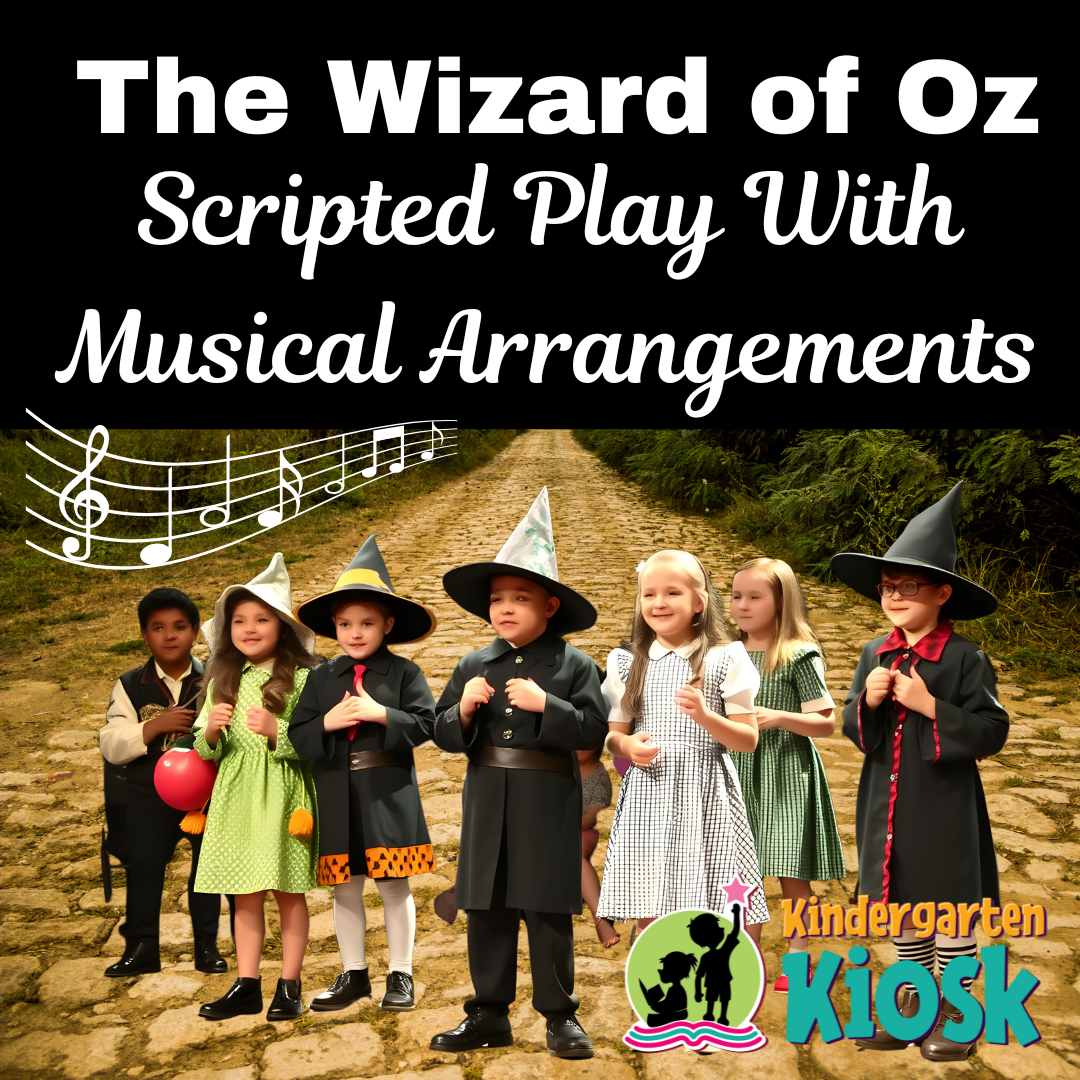
The Wizard of Oz, that is available below or at our TPT store is a great way to add the joy of music into your children's life.
Also available at Teachers Pay Teachers!
Description
Wizard of Oz and Wicked Fans alike will love this Wizard of Oz Musical Play for Young Children! Our goal is that as your students participate with this script and musical performance, they will, not only become more familiar with one of America’s great novels, but some musical history as well!
Put the Science of Reading into action the most authentic way possible! Integrate literature and music with this musical play of L. Frank Baum's classic The Wonderful Wizard of Oz, with song lyrics written by Baum himself! Your children will have the opportunity to participate in an experience they'll never forget.
These performance materials contain everything that you will need, including background information, 2 script versions (varying reading levels), sheet music for each song, and 2 mp3s for each song (one that has vocals to help the children learn the songs and one that is accompaniment only). These songs are both original and/or adapted by the Frank Baum's 1902 musical. This leads to a great opportunity for an author's study!
The parts for the play are: Narrator(s), Uncle Henry, Aunt Em, Dorothy, Locasta, Munchkins, Scarecrow, Tin Man, Lion, Poppies, Guardian of the Gate, Wizard, Wicked Witch, Flying Monkeys, Glinda, Chorus The numbers of poppies, monkeys, locust and munchkins can vary depending on class size. The show is easily adaptable in size!
There are ten songs in the play. (Of course you can add songs from the movies as desired).
Gray
Just a Little Girl
When We Get What's A-Comin' To Us
Locasta
The Poppy Song
The Guardian of the Gate
The Wicked Witch
Flying Monkeys
Humbug
Home Sweet Home
The performance lasts 30-40 minutes.
We have used this play with K-2 students and they love it!
What customers are saying...
"We have used this play with K-2 students and they love it!
"This was such a fun play!! Kids loved it."
"Great resource for my drama class! My students and I made adaptations and performed the play for our Spring Performance."