
Guided Reading - Building a Bridge to Reading Independence

Building a Bridge
Guided reading is the bridge between teacher-led reading activities and independent reading. It is an instructional strategy that helps students learn and practice the skills they need to become better readers. It can be used in many different grades, but it is most common in kindergarten, first, and second. Guided reading provides the support that children need to become readers.
“through guided reading... teachers can show children how to read and can support children as they read... It is the heart of a balanced literacy program — Fountas and Pinnell (1996)”
During guided reading, a teacher works with a small group of students that are working on similar skills. These groupings are not static, but change to reflect student needs and strategic teaching. During the lesson, the teacher selects a text that the students can read with support while working on the specific skill being taught. As children read the text, they practice and apply reading skills such as: using sight words, decoding words, using context clues, looking at word structure, and deciding if a word or sentence makes sense. During these times of supported reading, the teacher is able to scaffold students to a higher level of performance in a risk free setting.
“While there are many adjustments and variations related to the age and level of children, in guided reading:
- A teacher works with a small group. -Children in the group are similar in their development of a reading process and are able to read about the same level of text. -Teachers introduce the stories and assist children’s reading in ways that help to develop independent reading strategies. -Each child reads the whole text... -The emphasis is on reading increasingly challenging books over time. -Children are grouped and regrouped in a dynamic process that involves ongoing observation and assessment. — Fountas and Pinnell (1996)”

At the beginning of the kindergarten year, I am very concerned that students learn to track print. This is the primary strategy I teach during my first guided reading lessons. I call this strategy: Point at the word your voice is saying. It is important the children first learn to match their oral language to written language before we move on to other reading skills and strategies. I start with traditional guided reading books, but later add paper books to our lessons to provide a take-home, hands-on opportunity with text. The book “The Family” is a great example of one of the paper books that I use to help children learn the strategy of tracking print. I strategically teach this skill to my students using a mini lesson that comes before reading. The mini lesson is a powerful part of guided reading, during which I prepare students for the task ahead of them. Grab this leveled reader for FREE!
The Mini Lesson
Guided reading lessons usually open with a brief mini-lesson, during which a teacher prepares the students for reading. The objective of the lesson is tied to a skill the students will need in order to read the text successfully, and will be tailored to fit the needs of each individual group. Each group may work on a different mini lesson with a different book, or the same text can be introduced with different mini lessons. For example, when reading a book about bears, the teacher might give these three different lessons to different groups:

The book “The Family” is a great example of a paper book that awards opportunity to provide strategic practice with text. To make this book, simply copy pages 1 and 2, 3 and 4 on the back of each other, cut in half and collate. Copy page 8 and cut in half to make the last page of the book and a blank outside cover.
TRACKING PRINT
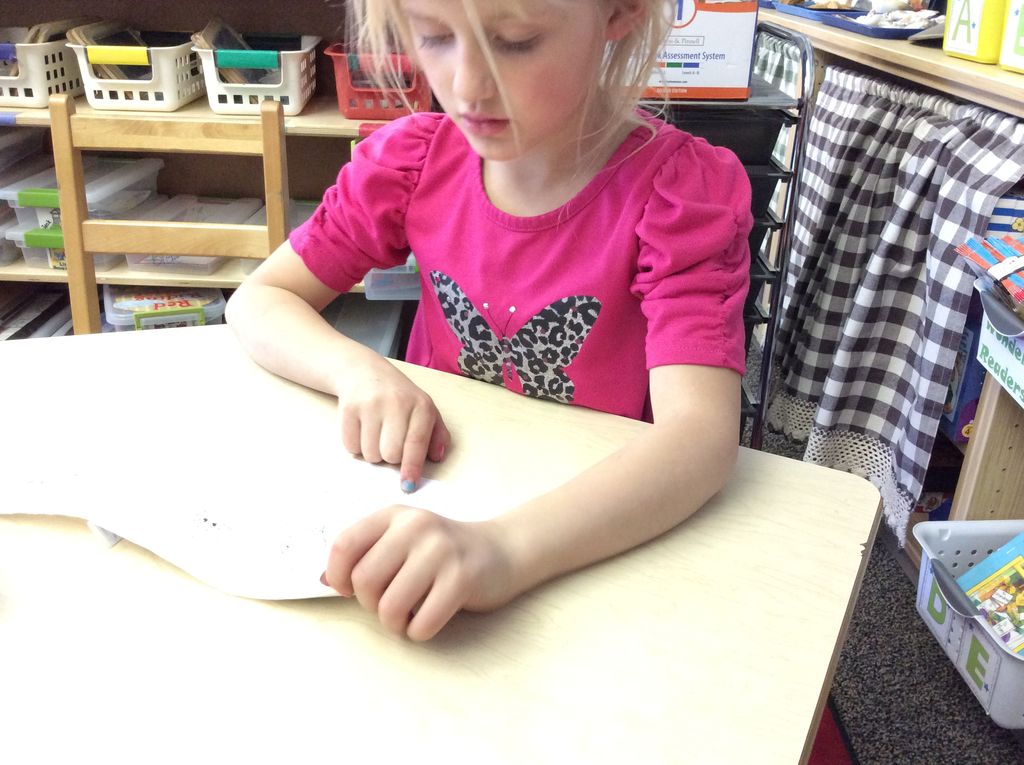
Place the word cards in a row to construct a sentence. “Think Aloud” as you place the cards, talking about the words, and drawing attention to the space between words. “I have a sentence. I will take my finger and point under each word that my voice is saying.” Point at each word one by one in a slightly exaggerated fashion. Ask students to read the sentence one by one pointing at each word as the word is spoken. After the activity, remind students that when you read today’s book, they need to point at each word as it is read. For lower level groups, use objects rather than words and allow students to practice naming an object only when their finger is pointing at it.
SIGHT WORDS
To practice the words in, the and will, (or the sight words included in your selected reader), first show the students each word in flash-card style. Next, pull out a small deck of cards (about 3 or 4 of each word) with the words in, the, and will printed on them. “We are going to play Hot-Potato-Word!” “To play, I will draw the top card and read it. I will then pass it to ____ (the person at my left), and then he will read it and pass it and we will read and pass until it gets back to me. I will then put the card in a container to cool it down.” After play, show the students a page of the book, ask them to find one of the sight words on the page, then remind them to look for the words in, the, and will (or your words) as they read the day’s book.
USING PICTURE CLUES

To practice this skill, use cards with words only, and cards with words plus pictures (like the cards provided with our mini-lesson kit). “We are going to read words by using picture clues.” First show the children a card with a word only. “Who can read this word?” (the majority of students will be unable to read the card). Next show a card with a word plus a picture. “Who can read the word now?" (most all students will now be able to read the card). “Why was it easier to read the word on the second card than the first?” (Let students respond). “It was easier because you were able to use a picture clue to help you read the word.” Continue with the remaining cards. Turn to a page in the reader that contains a word that the children are unable to decode, but can discern with a picture clue. Have the children practice reading that word, then remind them to use picture clues as they read their book.
PICK UP THE MINI-LESSON HELPS AND GUIDED READER FOR FREE At CHECKOUT!
A guided reading mini-lesson plus a guided reader on Bears.
Also available at Teachers Pay Teachers!
Students will read more quickly and effectively when given appropriate strategies for reading and instructed how to match those strategies to each reading situation. There are many important strategies to learn. This set focuses on the strategies that will enhance student reading during Guided Reading experiences.
This set includes strategy cards that you can use in your classroom to remind students of the strategies as you learn them. Also included are posters that you can use to teach each strategy. Print the posters on large paper if possible and display them where the class can see them. If you are using them in a whole group lesson you can print smaller versions. Each poster is followed by a lesson plan that will help you teach each reading strategy.
Introducing the Book
The key to guided reading is providing children enough support so that they will be able to read the text successfully while still using their problem solving skills. After the skill/mini-lesson portion of a guided reading lesson, it is time to introduce the book to the children in order to prepare them for independent reading. The teacher should be familiar with both the students and the text in order to prepare an introduction that will provide the right scaffolding for reading. Introductions can serve various functions, such as activating children's prior knowledge, introducing new or unusual language from the text, discussing themes or features of the story, introducing new vocabulary, or anything else that will help the group read the text successfully with a few opportunities for trying out their skills.
“This is not a case of telling the children what to expect. It is a process of drawing the children into the activity before passing control to the children and pushing them gently towards problem solving the whole first reading of the story for themselves. — Clay (1991)”

For example, if the book is about turkeys, a teacher could activate prior knowledge by asking students what they already know about turkeys (you can simply accept responses and make it an oral conversation, or you may wish to record responses and make a list or a spider-graph to record responses). Next, the teacher uses the responses to draw interest toward the text about to be read. The teacher may also wish to follow student responses with a personal experience with the subject. My students always love to hear my story as a young child growing up on a farm that not only had cows, horses, pigs, and sheep, but thousands of turkeys! I show them a old clip of when my brother put me in a pen with the turkeys. The clip shows me running from the turkeys while the mercilessly chase me wherever I go. After the video, I show a turkey feather that I kept from my childhood days on that farm.
Another simple, but effective way to introduce a book is to take a “Picture Walk.” The picture walk is a time for students to discuss pictures, make predictions, front-load vocabulary, and fill conceptual gaps.
To begin the picture walk, the teacher holds one copy of the text for students to view. As she turns the pages one-by-one, she asks questions such as “What is this a picture of?” “What is happening in this picture?” “What clues about the story do you think this picture is giving us?” “What word(s) can you use to describe this picture?” “What picture do you think will be on the next page?”
During the picture walk the teacher should implant vocabulary that is found in the book. For example, if a page contains the word brown, the teacher might say on that particular page, “Yes. It is a bear. He looks like a brown bear to me.” If the word snout is found on the page, the teacher might say, “I think the bear on this page has a huge snout!” “Do you know what a snout is?”
Following the introduction, the teacher passes each student a copy of the guided reading book and invites students to point at each word as s/he reads the story. During this reading, the teacher models good reading behaviors such as tracking print, phrasing, inflection, etc. as students follow or read along.
Next, the group turns back to the cover and reads together as a group (choral reading). During this time, the teacher guides, observes and supports. Following this reading, the students re-read independently as the teacher focuses on one student at a time. Following, the students should re-read the book at least one more time. One way to accomplish this is to have a basket of book-buddies (stuffed animal pets) available for the students to read the story to in the classroom library, at another table, or other location in the room, and then return back to the reading table when that task is completed. This will allow the teacher to keep one or two students at the table that may need additional scaffolding.
Reflect and Respond
Following the reading, it is a time to reflect and respond to the text and the strategies used to read the text.

Making puppets as a response to reading.
There are numerous ways that students can be given an opportunity to make connections with a recently read guided reader. One is simply by using conversation: “Turn to your neighbor and tell them your favorite part of the the story.”
Another way is to construct a Story Map listing the characters in the story, setting, and problem. Or you may choose to make a Retelling Map listing the beginning, middle, and end of the story.
You may also choose to have a Guided Reading Journal for each student. Following the reading of the guided reader students can turn to their next page and write at their level of independence, about the story. Or you may ask them to concentrate on specifics of the story such as sight words, CVC words, rhyming words, beginning sounds, or other skills of focus.
Assessment
After students have received instruction and support, they need to read the book at an independent level. Provide opportunities for them to read to teacher, read to peers, read to self, and read to parents.
One of the most important pieces of a guided reading lesson is assessment through running records. This is a very useful tool and deserves a whole section of its own. Look for that soon!
If you would like to learn more about guided reading, this is a great resource!

Also available on Teachers Pay Teachers!
Product Description
127 Guided Readers For Emergent Readers.
Check out one being read here: https://www.kindergartenkiosk.com/guided-reading/2/19/ell-kindergarten-reader
You will love these engaging guided readers that bridge the gap from non-reader to reader. These books can be copied, and then offered for guided reading practice. Students can participate in tracking, phonics practice, decoding, picture clues, and other important reading strategies right on their own copy!
Offering students a paper book that can be read, colored, and taken home offers students authentic purpose for the guided reading instruction and opportunity to practice techniques at home. This in turn offers parents important opportunities to be part of classroom reading instruction. Students love these delightful stories that are ready to read, on an emergent level. The clip art is delightful!
These sets may be purchased separately for $4.00 a set. Or, you may purchase this entire bundle for $50.00, a great savings of $34.00. That is $.25 a book!
Apple & Pumpkin Themed Emergent Guided Readers
Apples
The Pumpkin Cycle
Pumpkin Colors
Pumpkin Patch
Apple Picking Time
Back To School Themed Emergent Guided Readers
The School
School Rules (A Read Together Book)
All About Me
My Classroom
Friends
Names
Bear Themed Emergent Guided Readers
My Teddy Bear
The Brown Bear
Little Bear and Friends
Bear Facts
Color Bears
The Three Bears
Christmas Themed Emergent Guided Readers
Merry Christmas
Presents From Santa
The North Pole
Run Gingerbread Man Run!
The Christmas Train
Color Themed Emergent Guided Readers
Blue (Color)
Blue (Black & White)
Green (Color)
Green (Black & White)
Orange (Color)
Orange (Black & White)
Purple (Color)
Purple (Black & White)
Red (Color)
Red (Black & White)
Yellow (Color)
Yellow (Black & White)
Dinosaur Themed Emergent Guided Readers
Dinosaurs -- Level A
All About Dinosaurs -- Level C
Dig A Dinosaur -- Level C
The Little Dinosaur -- Level B
The Paleontologist -- Level B
Fable Themed Emergent Guided Readers
The Little Pigs
The Little Goats
Jack and the Beanstalk
The Little Red Hen
Fall Themed Emergent Guided Readers
1. Falling Leaves
2. The Autumn Leaves
3. Autumn
Colors of Fall
Farm Themed Emergent Guided Readers
The Farmer in the Dell -- Level A
The Sky is Falling -- Level CC
The Watermelon -- Level C
The Farmer -- Level C
Where are the Animals -- Level B
February Themed Emergent Guided Readers
Little Hearts -- Level B
I Love -- Level C
My Valentine -- Level C
Brushing Teeth -- Level C
Groundhog Day -- Level B
The Days of School -- Level C
President's Day -- Level B
Halloween Themed Emergent Guided Readers
Halloween Night
Little Witch
The Chocolate Chip Ghost
Trick or Treat
My Halloween Costume
Pat the Bat
May Themed Emergent Guided Readers
What I Can Do Now
My School
My Friends
Summer Vacation
Ocean Themed Emergent Guided Readers
At The Beach - Level B
The Ocean - Level B
The Ocean - Level A
The Sea - Level C
Diving in the Sea - Level C
Willy The Whale - Level C
Picture Book Themed Guided Readers
The Big Red Dog
Little Caterpillar
Goodnight At The Zoo
This Little Piggy
The Brown Bear
Five Little Monkeys
Pirate Themed Emergent Guided Readers
I Like Pirates-- Level C
X Marks The Spot-- Level E
The Pirates -- Level C
The Treasure -- Level D
Sight Word Themed Emergent Guided Readers: Volume 1
I Have
Jobs
Going to School
Not!
It Is For
I Know
Sight Word Themed Emergent Guided Readers: Volume 2
The Pet Show
Dad
On
Look!
I Said
We Can
Space Themed Emergent Guided Readers
The Stars -- Level D
My Rocketship -- Level C
Space Explorer -- Level B
Rockets -- Level C
The Aliens -- Level B
Spring Themed Emergent Guided Readers
The Lamb and the Lion
Welcome Spring
The Cat’s Hat
St. Patrick’s Day
The Little Seed
The Bunnies
Winter Themed Emergent Guided Readers: Set #1
Happy New Year
How To Build a Snowman
My Snowmobile
Cocoa
Ice Skating
Winter Themed Emergent Guided Readers: Set #2
Winter
Winter
Snow
The Mitten
The Mitten
⭐ Alphabet Zoo Games: For Early Readers
⭐ Apple & Pumpkin Themed Sight Word Readers
⭐ Apple Experiment Guided Reader
⭐ Back To School Sight Word Readers
⭐ Bear Themed Sight Word Readers
⭐ Christmas Guided Readers
⭐ Color Themed Emergent Guided Readers
⭐ Dinosaur Themed Sight Word Readers
⭐ Fall Themed Emergent Sight Word Readers
⭐ Farm Themed Sight Word Readers
⭐ February Themed Guided Readers
⭐ Halloween Emergent Guided Readers
⭐ Henry Penny: Reader's Theater or Partner Play
⭐ Jack and The Beanstalk: Reader's Theater or Partner Play
⭐ Little Red Hen: Reader's Theater or Partner Play
⭐ Little Red Riding Hood: Reader's Theater or Partner Play
⭐ May Themed Guided Readers
⭐ Ocean Themed Sight Word Readers
⭐ Picture Book Themed Guided Readers
⭐ Pirate Themed Sight Word Readers
⭐ Reader's Theater or Partner Play: Folk Tale Bundle
⭐ Reading Strategies Charts: Building Effective Readers
⭐ Sight Word Readers Volume 1
⭐ Sight Word Readers Volume 2
⭐ Space Themed Sight Word Readers
⭐ Spring Themed Guided Readers
⭐ The Shoemaker and the Elves Readers' Theater For Early Readers
⭐ The Wizard of Oz Musical or Reader's Theater
⭐ Three Billy Goats: Reader's Theater or Partner Play
⭐ Three Little Pigs: Reader's Theater or Partner Play
⭐ Winter Guided Readers: Set #1
⭐ Winter Guided Readers: Set #2
You will love this bundle of guided readers. Each set is also available for purchase seperately.
As with all of our products, they are available here, or at our TPT Store.

Shop all guided readers here: http://www.kindergartenkiosk.com/commissions