
How Many Sight Words Should I Teach?

Reading is a complicated process that involves multiple points of understanding along the way that lead to the connection of text and understanding. These points of understanding include instruction in phonological awareness and phonics.
Phonological awareness includes instruction in rhyming, sentence segmentation, syllable blending and segmentation, onset-rime blending and segmentation, generating beginning, middle, and ending sounds in words, blending and segmenting the individual phonemes in words, and phoneme deletion and manipulation. If children do not receive the proper instruction in any of these points of understanding, it may lead to issues as reading independence matures, Especially when children are faced with the task of decoding multisyllabic words in content area texts. When these difficult words are encountered, a reader needs to rely on all of his/her acquired reading skills; an understanding of phonemes and their relationships to each other as they are manipulated to form words.
Shaywitz et al. (1999) asserted in their research that students who are unsuccessful in reading words that are unfamiliar to them may also struggle with poor (under-developed) phonemic awareness skills. As without the auditory awareness of phonemes and how they work together students struggle to sound out these more advanced words.

Phonics includes the all-important letter-sound relationships, sight words, reading strategies, vocabulary, comprehension skills, and meaning. Of course, all phonics skills are of paramount importance and this includes sight words!
I have expressed my frustration with current trends in teaching that include an over emphasis on teaching sight words as a means to achieve early reading. However, I don't mean to imply that we should not teach sight words at all, as it is an important part of reading instruction for emergent readers. In fact, most beginning readers can be easily read with the knowledge of a few sight words and the strategy of using picture clues.
The issue I have encountered is, as a reader advances, knowledge of how to attack multi-syllabic (or simply put) longer words, is crucial when it comes to content area reading. In fact I would say that the lack of phonemic/word-attack knowledge plays a part in the so-called 3rd Grade slump. Consequently, it is important to remember that over-loading students on sight words sometimes masks an inability to sound out words. I have especially noticed this problem with students that are visual learners. Memorizing sight words is easy for them, they move quickly up the emergent reading levels until their levels are filled with words that are only decodable. This becomes a hurdle for those kids. A greater amount of phonemic practice would have better served them than a trophy amount of sight words.
The important thing to remember when teaching early reading skills is that ALL of the components of effective reading are equally important and they all should be addressed.

A new study published by Developmental Psychology concludes that the best predictor of student future reading success is the ability to use invented spelling while writing. This study does not surprise me at all, in fact invented spelling is the best way for students to put phonological awareness as well as phonics into practice. During this process, students are able to reflect on how to spell a word (auditory) while making written decisions (visual) and putting those decisions on paper (graphophonic). Through this process, knowledge is put into practice rather than simply memorizing words. Of course, a bank of sight words helps the writing and reading process, a posted word wall in the classroom is imperative. A bank of sight words that can be easily read, spelled, and written is imperative. But not at the expense of the ability to decode and write.
In conclusion, yes, sight words should be taught. However, a developmental number for typically developing kindergarten age students would be 30 or less. Students that are ready (with advanced phonemic awareness) of course should be challenged with more.
Students need the knowledge that reading is a mix of memorized words and decodable words not just a regurgitation of memorized words. Face-it now matter how we try, their are simply too many words in our language to memorize.

Also available at Teachers Pay Teachers!
Syllables Games and Activities
This packet includes activities to help your students understand the concept of syllables. The lessons vary in style and format. Some lessons are scripted, others are designed for independent practice. Some lessons can be used with small groups while others can be completed with a large group. All lessons can be adapted to support struggling students or to challenge high-achieving students.
The unit is organized into 16 lessons to be spread out during 4 or more weeks.
Contents:
Week 1
Clapping Names
Syllable Objects
The Syllable Walk
Syllable Count
Week 2
Color Walk
Off To See The Wizard
Family Fun
Syllable Sale
Week 3
Animal Sort
The Country Store
Squirrel Sort
Race Up the Ladder
Week 4
Counting Syllables
I Can Syllables
Pumpkin Patch
Haunted House Syllables
© Kathy Crane Kindergarten Kiosk
Related Products
Follow For Updates and Freebies!
Be alerted as products are updated and/or added to. Get Special Freebies.
Also available at Teachers Pay Teachers!
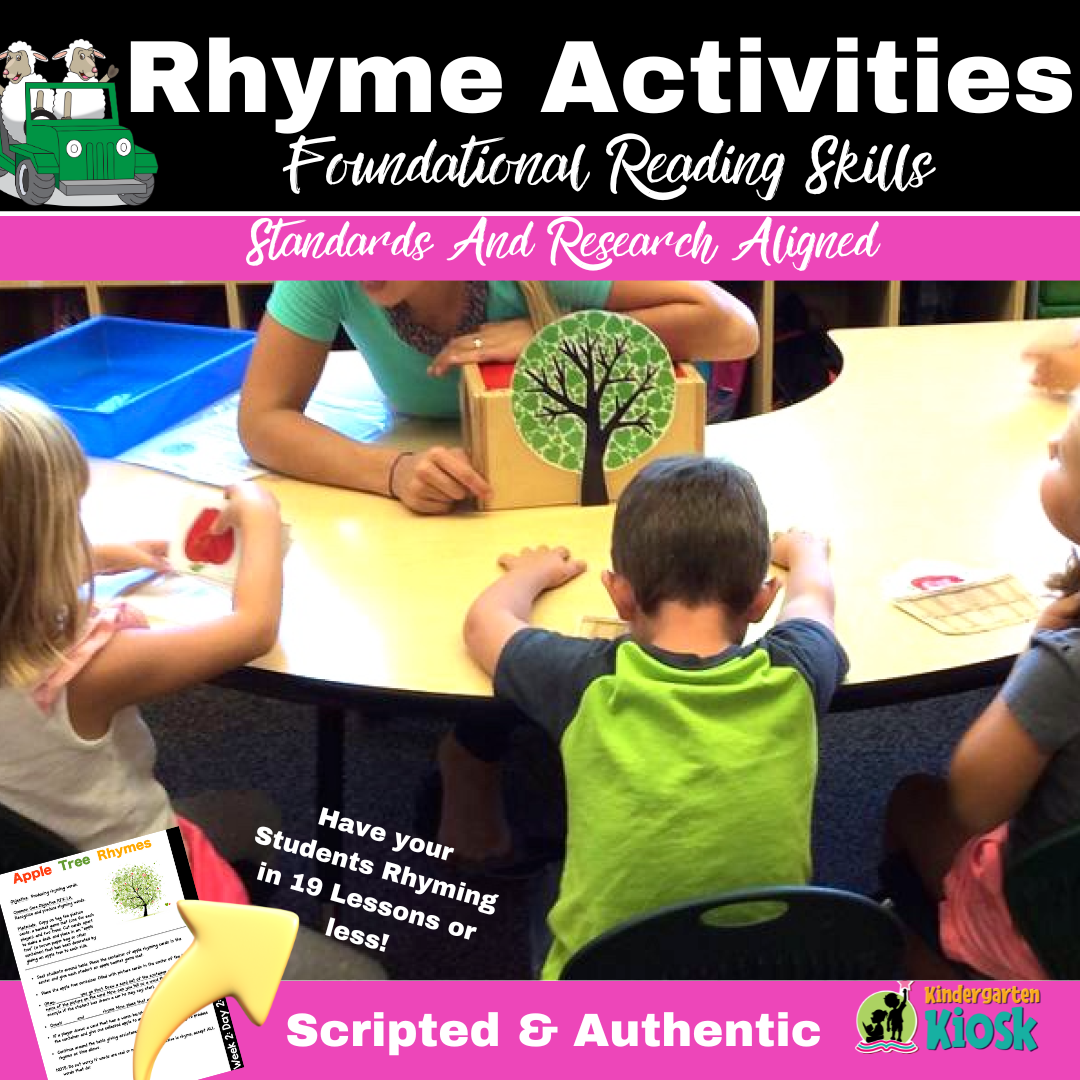
This packet includes activities to help your students understand the concept of rhyming. The lessons vary in style and format. Some lessons are scripted, others are designed for independent practice. Some lessons can be used with small groups while others can be completed with a large group. All lessons can be adapted to support struggling students or to challenge high-achieving students.
The unit is organized into 19 lessons to be spread out during 7 weeks. Many of the Teach Me To Read Units are meant to be taught in tandem, following the learning to read timeline.
Here is the link for the syllable unit: https://www.teacherspayteachers.com/Product/Teach-Me-To-Read-Syllables-833730
Table of Contents Week 1 Day 1: Nursery Rhyme Time
Week 1 Day 2: The Hungry Duck
--------------------------------------
Week 2 Day 1: Buggy Rhymes
Week 2 Day 2: Apple Tree Rhymes
--------------------------------------
Week 3 Day 1: Web Treasures
Week 3 Day 2: Roll and Rhyme Halloween (or any season)
Week 3 Day 3: Halloween Rhyme Time
--------------------------------------
Week 4 Day 1: Picture Pairs
Week 4 Day 2: Rhyming Flags
Week 4 Day 3: Turkey Lurkey Rhymes
--------------------------------------
Week 5 Day 1: Rhyme Me a River
Week 5 Day 2: Le Revelillon
Week 5 Day 3: To The North Pole
--------------------------------------
Week 6 Day 1: The Lost Mitten
Week 6 Day 2: Planes Trains and Everything Else
Week 6 Day 3: Match a Rhyme
--------------------------------------
Week 7 Day 1: Rhyming Sunglasses
Week 7 Day 2: Home Tweet Home
Week 7 Day 3: T-Shirt Twins
Also available at Teachers Pay Teachers!This packet includes six lessons to help your students understand the concept of phoneme isolation and fulfill Common Core Standard RF.K.2d.